The Value of Internal Side Gigs

Nowadays it’s common for people to have a secondary source of income to supplement their primary job/career. Common examples include participating in the gig economy (Uber, SkipTheDishes, etc.), monetizing a hobby (Etsy), and freelancing (Upwork, Fiverr). I’ve taken a slightly different approach in where I’ve almost always had a side gig but internally. Over 15 years into my career I think this strategy has and continues to pay off. In this blog I’ll share what some of those internal side gigs were and more importantly how they’ve benefited my career.

Internal Side Gig #1: Acquisition Integration Focal

In 2007/08 I was fortunate to work on what was then IBM’s largest ever acquisition of Ottawa-based Cognos. I led the Canadian IT integration. Coming out of that project I took on the role of being the Canadian Acquisition Integration Focal, meaning I helped work on any acquisition that had a Canadian presence. This was in addition to my day job as a project manager in our Canadian Development IT organization where I worked on numerous IT projects. IBM was extremely acquisitive at that time so on top of my day job I worked on acquisitions such as Algorithmics, Varicent, Q1 Labs, and many others.

There were two primary benefits I gained from this role: learning to work with executives and networking with functions outside of IT. Because acquisitions are critical to IBM’s strategy I’d need to work with executives including our Lab Director on overall progress, solving issues, education, and more. Because acquisitions are complex I’d need to work with colleagues in HR, Finance, Real Estate, Operations, and others – this built my network significantly. One of the HR leaders I worked with on the Cognos acquisition is the same HR leader I work with in my current role; I believe that my good work 12+ years helped give me instant credibility when I took on this role in late 2020.

Internal Side Gig #2: IT Cost Focal

After the economic crisis in 2008 naturally managing costs became a major focus across IBM. In 2009 we kicked off numerous initiatives to manage our IT spend including working with sister development Labs across IBM. We’d crawl through the IT budget line by line to identify areas to optimize or eliminate spend. This was my primary focus for a couple of years but I kept this responsibility even when I first became a manager in 2013, which is when one could argue it became a side gig, and even after I took on my second team after a re-org in 2016. I kept this responsibility for a decade until I left the IT organization in 2019.

There were three tangible benefits that came from this. First, I learned how the financial side of running a large organization worked including how to do more with less. I delivered millions in cost savings over those years. Second, similar to my previous example, it gave me immense visibility with working with numerous IBM executives from whom I learned a lot. Third, one of the people I worked with on two big projects – one that involved combining six global IT teams into one organization and another focused on consolidating 30+ data centres down to a handful – is also a peer in my current role. The reputation I built back in 2016-2017 as part of those projects is paying dividends today as I had and still have the credibility to always do the right thing for the business.

Internal Side Gig #3: Toronto IBM Club Board Member

For 70+ years there was a volunteer-run local organization called the Toronto IBM Club (TIC) which provided a set of events, clubs, and perks to IBMers. In 2013 they were looking for a board member to become their Technology Executive and I was recommended to take on the role by my then-manager, which I did. I held the role for 3 years.

This was a great experience and there were two tangible benefits that came from this role. First, I gained experience being part of a board that ran a historically important organization. Second, I gained some close friends including one whom I’m still very close with today; we are both entrepreneurial minded and have had great conversations over the years on new business ideas. In fact we almost launched a start-up together!

Internal Side Gig #4: Robotics Club

I didn’t realize it at the time but I spontaneously volunteered for something in 2017 that probably led to me getting my previous and current role. We had a new Canadian Lab Director who was focused on transforming our Lab from a dreary, cost-focused environment to a vibrant place that employees love to work at. I was still managing the IT budget although the importance of this was waning. At one of the updates we were giving he mentioned an experience he had at a hotel where robots were involved, and wanted to explore whether we could do anything with robots at our software lab to improve both the employee and customer experience. I volunteered to take this on.

I had no budget and no team but I was able to source a couple of robots from around IBM and built a small group of volunteers who started exploring what things we could do with these robots. Through this I got to present one of our little robots at one of our Lab-wide townhalls which was the first time I was able to be part of such an event. This ended up being extremely funny because the robot hilariously malfunctioned in front of the live audience of thousands, and I ended up being known as the robot guy.

While robotics had nothing to do with my then-role in IT, this gave me significant visibility with the new Lab Director. In 2019 he was looking for a manager to take on a new team, and offered this role to me which led to me becoming one of the Senior Development Managers who brought IBM Watson AIOps to market. Had I not volunteered for the robotics “program” two years prior, I probably wouldn’t have been known and I wouldn’t have been considered for that role. The work I did in that role subsequently led me to my current role, so I credit this side-gig with opening two amazing doors for my career.

Conclusion

I’m fortunate to work at a large global organization that has an immense amount of opportunities. Early on in my career I made a choice to double down on opportunities internally with the hope that they would benefit me longer term. Could I have kept only doing my main job and spent my free time externally on other things? Of course, and that may have led to immediate tangible benefits. But I truly believe this strategy has paid off both figuratively and literally due the experiences my internal side gigs have led me to.

By the way, I still do this today. I volunteer for almost every mentoring/coaching event that I’m invited to, own the IBM relationship with a university where I help judge their senior thesis projects every year, co-lead our electric vehicle community at work, help our campus recruitment team with events at various colleges and universities, and much more. Who knows what doors these things will open in the future…

Men as Allies in Tech – My Reflections

This past week I finished a six-session pilot program titled “Men as Allies in Tech.” Each session was a 2 hour live virtual class followed by an hour of homework. This pilot was run by an organization called Women in Tech World and had men from three major organizations participate: the Federal Government of Canada, the University of Ottawa, and IBM Canada. The goal of this pilot program is “to provide a safe space for men who manage tech teams to raise awareness and education on gender equity in the workplace and provide concrete, actionable takeaways for use in daily allyship. ​ Participants will be supported in shifting their lens and building new skills to act as allies and partners for women in tech.” Based on the feedback from the facilitators and participants it may become a permanent program for men to take.

I have to say, this was one of the most enlightening, hardest hitting, yet inspiring programs I’ve ever taken. In this blog I’ll share a bit about what I learned and what I plan to do differently to be a better ally for women in technology. I won’t rehash all the damning facts that support the notion that this is a real problem – there are plenty of studies/articles easily found via your favourite search engine – but I will assume that you, the reader, accept this problem to be true. I’ll also caveat this to state that I’m writing this from a binary women-men perspective for simplicity’s sake but the situation is much worse for LGBTQ+ persons and minorities.

My Key Takeaways

  1. The situations women face at work are mind-boggling. While I’ve known that many women face hurdles during their tech careers, I was somewhat oblivious or naive to some of the horrible situations that so many women have had to deal with. We heard stories from women about these situations and you almost didn’t want to believe what you’re hearing, yet they’re real. What’s worse is that many happen in group settings where people present do not speak up about the seemingly obvious transgressions.
  2. Microaggressions are rampant. Beyond the bigger situations, many women face microaggressions on a daily basis. There are constant comments or actions that affect women’s ability to perform at their best free of discrimination. Some microaggressions are obvious; others are more subtle.
  3. The difference between mentorship and sponsorship. I especially found this insightful. A common solution well-meaning organizations implement is more mentorship of women. This is not bad by any means, but it’s not sufficient. What we learned is that there are networks and systems that many women simply do not have access to. Two examples include company boards which are made up of exclusively or mostly men, and after work social events that aren’t convenient for women with children or taking care of elderly relatives. Women need access to these networks in order to proceed in their careers, thus sponsorship from those in those networks is necessary. If you have 12 minutes to spare check out this excellent HBR podcast for more on this topic.
  4. Some men are oblivious of how they negatively impact women. This is not meant to be an excuse, rather recognition that there are systemic, cultural, societal, and other factors that result in many men simply not having a clue about how the things they say or do affect women. I’m guilty of this myself. This implies that there’s a level of education/awareness needed that isn’t prevalent enough in workplaces. All of the men who participated in this pilot program came in with varying degrees of knowledge/experience on this topic yet all walked away learning more about how they as people and their workplaces can evolve to be better.
  5. No knights in shining armour required. Women don’t need men to come in as heroes to solve these problems. What women are asking for is an equal playing field where they can bring their full selves to work, be free from microaggressions and other worse situations, and have access to the networks and systems that lead to career progression.

There were a lot more takeaways but these were the ones that really stuck with me.

By the way, this kind of situation doesn’t just happen in corporate workspaces. This past weekend my wife ran into a microaggression and asked me for my insight on how to address it. She is a family physician and is working with a vendor to purchase some software. While her email name and signature state her “Dr.” title the male salesperson she’s working with kept referring to her by her first name only. This isn’t the first time she’s run into this. She has (and probably most female doctors have) observed that her male peers are consistently appropriately referred to as “Dr. surname” yet female doctors are consistently referred to by their first names only. Normally I’d advise her to let it go but based on my learning from this program this time I suggested she should call it out directly with the salesperson when they met on Monday for a demo. Fortunately he used her appropriate title so a potentially confrontational/awkward situation was avoided.

A program like this is useless if it doesn’t drive change, and the final session was dedicated to creating action plans on how we’d implement what we learned at work and at home. Here are some of the actions from my plan:

  1. Actively watch for microaggressions in my own actions and by others, and not let them go unaddressed. Admittedly this one will be tough. One example is I want to stop using the term “guys” to refer to groups that include or are exclusively women. Yet it’s so ingrained in my style of writing and speaking that twice since I set this goal I referred to groups of exclusively women as “guys” – argh. The other easier-said-than-done part will be how I handle calling out microaggressions from others, especially potentially from those in higher levels of the organization.
  2. I run two organization-wide intrepreneurship programs at work that involve people pursuing innovating differently than via their typical day jobs. Relative to the percentage of our population, the number of women who participate in these two programs is low. I am working on analyzing how we’re marketing/positioning these programs to determine why we’re not attracting more women. I’ve had two conversations with colleagues so far and received feedback from one that these programs feel like “just one more thing” that women have to do (especially during the pandemic where women have many additional pressures) and got suggestions from the other on groups that we could market the programs to for better awareness. There’s more that will be done here in the coming weeks.
  3. Use the power of my role to sponsor more women. My current role as Chief of Staff to the VP of Development of our 4,200+ person global development organization means I have a lot of influence across our organization. I can use my platform to help support many of the incredibly talented women in our organization. I’m not exactly sure how this will manifest so I have to spend more time developing this action. Ideas are welcome!
  4. Listen more. Seek out women’s perspectives on how announcements, programs, events, etc. work or don’t work for them and make changes to be more inclusive.

I said earlier that this program was inspiring. I’m hopeful of a better future just based on the fact that this pilot took place, and that it may become a permanent program. I’m equally inspired by how open/willing my peers who participated are to growing themselves and making meaningful changes within their organizations and with their colleagues. We were made aware of organizations working in this space, many of which I now follow on Twitter, and I’m inspired by the conversations and initiatives I’ve been reading about on social media.

To summarize, I consider myself fortunate to have participated in this pilot program and I truly hope it becomes a permanent course that other men can take and learn from. I know that I cannot solve this problem by myself but I can be a part of the solution, both personally and by guiding/helping other men. I also realize I’m not fully “woke” yet on this topic and that I have more to learn, which I’m committed to do. While I’ll strive for more, if I can help a handful of women have a better experience at work and advance in their careers then I consider that the minimum bar for success.

I welcome feedback on this blog.

Just Pick Up The Phone!

Working in tech gives me the opportunity to play with some of the latest communication apps and tools.  In the past couple of years a few products have sprung on the scene that are revolutionizing the way individuals and teams communicate and collaborate, such as Slack, Trello, Mural, and Microsoft Whiteboard, along with better versions of Box, Webex and Zoom.  There are many more but these are the ones I use at IBM that I didn’t 2-3 years ago.  Yet recently, in spite of all these great tools, I am finding that the advice I’m giving to my team and following myself is a bit more old school: pick up the phone and make a call.

Here are three recent scenarios where I believe making a phone call led to a better outcome than using technology would have led to (yes, I’m considering a phone call to not be “technology”):

  1. Due to a small re-org a few people joined my team of direct reports.  I asked one of them to partner with a person from my original team on a small but important initiative.  The two of them live/work in different cities and are generally quite different individuals, yet both deliver great results in their own unique ways.  There was a bit of conflict which I attributed to style issues.  I suggested to one of them to pick up the phone and call the other with the goal of building a personal relationship by sharing backgrounds and talking about how to approach the initiative.  That one phone call led to a much better working relationship and overall a better end-product.
  2. Like many workplaces we’re going through a significant transformation in multiple parts of the business.  I’m specifically driving a global initiative on the private cloud technology IBM developers use to do their work.  I received a fairly scathing email from one of my customers who was legitimately annoyed at the churn we were causing by asking his team to transition to a new platform which ended with him stating he was not going to continue to work with us.  I could have responded to his email with a lengthy response addressing his issues but instead responded and offered to set up a call to discuss.  On that call I empathized with the situation, gave him context on why we were making these changes, and committed to working with him through the changes.  What was the end result?  He seemed quite positive and committed to working with us.
  3. Similar to the previous example, I received an email from a customer with a ton of questions after an unplanned outage.  The email cc’d a couple of executives so I had to tread carefully.  The easy answer was to factually respond to each of the questions via email.  Instead, I set up a call and we talked through the details.  The call was also positive and we were able to identify areas to improve collaboration should a similar incident occur in the future.  I then followed up with an email summary so that the executives were aware that we closed the discussion satisfactorily.

So why is this important for Millennial Leaders, especially those at tech companies and doubly more so for those with employees in a different city/country?  At the end of the day conducting business is a human endeavour.  AI and robots haven’t taken over yet.  This means that we need to keep nurturing interpersonal bonds.  For Millennials and Gen Z’ers who could theoretically live our entire lives – work, social, etc. – through a screen, once in a while we need to put the device away and talk to people in a more personal way in order to deliver great results at work.  Is it easy?  Definitely not, and I’m not perfect at it either.  Sending a quick IM via whatever tool is easy but the goal should be to pick up that phone or walk to someone’s desk.  Try it!

He Shoots, He Scores!

I recently read an article written by one of the world’s top footballers (soccer players) which reminded me about a vital factor in being a great leader to those you lead. If you have 7-10 minutes please give the article a read. I found it extremely insightful and it honestly moved me a little.

I’ve Got Some Things to Say by Manchester United & Belgium’s Romelu Lukaku

Those who know me know that I’m a huge (fanatical?) football fan. However I don’t manage any footballers so why is this article relevant to me as a Millennial Leader? First, some background. Romelu Lukaku is someone I’ve been aware of for a few years as he played on other teams in the English Premier League, which I follow closely, but is not someone I knew of really well. In the summer of 2017 he joined my beloved Manchester United for an astronomical £75 million transfer fee with a monthly salary likely around £1 million. Over the past year, as a key player on my favourite team I’ve learned more about him and what strikes me the most is his passion for the game, his relentless running, and ultimately his results – he’s scored 37 goals (as of today’s date) across all competitions during the 2017/2018 season for club and country. After reading this article I now truly understand the motivation behind why he is so good at what he does (clue: it’s not just about money).

I took two things away from the article:

  1. A timely reminder that I need to ensure I know the motivation driving the people I lead and to stay current on it as it changes over time. This isn’t groundbreaking by any means; there’s a wealth of literature on motivation and its importance in leading teams. I will assume you agree that knowing each of your staff’s motivation is a vital ingredient to successful leadership so I won’t cover that in this blog.
  2. As a Millennial Leader, I need to recognize and empathize with the motivation of people in different generations whose motivation is alien to me. With that knowledge I then need to tie in work-related matters to each person’s motivation where possible.

With a broad range of employees on my team spanning from interns to those whose careers are longer than my life, it’s vital that I go beyond simply being aware of each person’s motivation. Leaders need to be able to closely relate to what drives their team members especially when a person is at a different stage in their career.

As an example, I can closely relate to someone who is just over a decade into their career, has a young family, and aspires to executive positions in their future. My motivation is likely similar to theirs. How I work, the things I’m willing to do or not do, and my career risk tolerance are probably consistent with theirs, leading to a better working relationship and better results.

It’s harder for me to relate to someone nearing the end of their career, perhaps with declining health or worries about their financial situation in retirement, who may also have children in post-secondary education or elderly parents they’re taking care of (or both). Because I’ve never been in that situation it may lead to a lesser working relationship if I’m not willing to mentally step into their shoes and try to understand their motivation. I was fortunate enough that growing up my parents never had to mix water into my milk to make it through a week so without some deep thought I wouldn’t be able to fathom how that impacts and potentially drives someone.  And to be clear, you can think about it all you want and you’ll never truly understand it however it has to be more than just a cursory thought.

What are some techniques a leader can implement to understand and leverage someone’s motivation?

  • Informally, get to know your staff beyond just their business deliverables. Talk to them about more than just work; build rapport over time.
  • Formally, make relationship building part of reviews and career discussions. I personally start every one-on-one I have with my team with a very simple question: how are you doing? I’m not asking about work when I ask that question.
  • Periodically ask specifically about what their motivation is. If you use a template for career discussions make that question part of it. Add it to your list of interview questions too.
  • Ensure opportunities are tied to their motivation. If someone is 6 months away from retirement giving them a 1-2 year high stress project isn’t smart.
  • If you observe a change in one of your employees check in with them to see if anything major has happened.
  • Ensure recognition is tied to their motivation. If someone is motivated by money then monetary recognition is the obvious answer. If they’re family focused or like to go on vacations as often as they can then paid time off will potentially resonate more.

To summarize, each person is the sum of all of their experiences and no two people are the same. We’re motivated by different things and those motivations change over time. As a Millennial Leader it’s vital that you take the time to deeply understand what drives each person you lead – especially those who are most different than you or at a different stage in their career – and then leverage that knowledge to be a better leader for them.

Speed Bump or Brick Wall?

A few months ago a close friend asked me for some advice regarding his situation at work, and, with his permission, I wanted to share both the situation and the advice I gave him. This is a very common challenge that many Millennials face in their roles given the generational workforce dynamics occurring today, whether they are in leadership roles or not. While I have not directly been in the same situation it’s one that I see constantly around me that affects many people.

Alex (not his real name) is very passionate about his company and the industry he’s in. He has been in the same role for a couple of years and has been able to master it sufficiently where it’s no longer challenging. He wants to learn about different areas of the business, possibly even move to a different area, so that he can expand his knowledge and contribute more to the company. I call this “the itch,” where you want a change to advance or challenge yourself in a new way that isn’t driven by something negative; it’s just a feeling where it’s time for something new.

The issue is his manager. She is not willing to let him move to a new position, take on stretch assignments with other teams, or grow his responsibilities within the team. Alex feels boxed in. He suspects that it’s due to him being a top-contributor and his manager does not want to lose his skills from her team given the overall risk to the department’s ability to deliver its mission. He has made attempts to ask for more challenges but has been rebuffed each time.

His manager has been in her role for many years and has made it clear that she has no intention on moving to a new role. She’s had a long career and Alex’s view is that she is coasting to retirement while trying not to rock the boat in the process. Like your retirement portfolio as you near retirement, lowering risk is a logical approach for many managers reaching the latter stages of their careers so one can empathize with what Alex’s manager is likely doing. However one can equally empathize with Alex’s situation where he wants to do a lot more but is being blocked due to his risk-averse manager.

When he reached out to me we had a few lengthy conversations over a couple of weeks. I gave him the following suggestions:

  • Initiate a career discussion with his manager where he asks for her help in planning the next 2-3 years of his career, then identify some immediate next steps that will help reach the identified goals.
  • Reach out to executives in other areas of the company to seek out opportunities that may exist that he and his manager may not be aware of, and to network.
  • Network with others in the company to build broader relationships and build his presence
  • In parallel, look for roles at other companies in case nothing works out internally.

I checked in a few weeks later. He had followed the first three suggestions and parked the fourth as he genuinely wanted to make it work at the company. The career discussion with the manager didn’t go well. Alex felt his manager deflected a bit and made some half-hearted promises to look into opportunities. A few months later he was offered an opportunity to move into a temporary management role leading a team of 60(!) people while the current manager was on a medical leave. This had nothing to do with the career discussion they had nor Alex’s career interests so he felt this was more of a checkbox exercise to say an opportunity was presented. He connected with some executives but most deferred him to his manager; this suggests a broader risk-averse culture amongst the leadership team at his company. He continues to network as well. However, his situation has not changed and his frustrations are increasing. He may start looking externally, which in my mind is a shame given that his company may lose a motivated top-contributor.

What ideas or advice do you have for Alex? Should he continue to wait it out and hope for some change? Should he leave his company? Please share your suggestions and stories in the comments.

Generational Change Management

Change is hard for most people. Generally speaking we humans are creatures of routine who find comfort in repetition. There are obviously those who thrive under changing circumstances or in chaos but they’re in the minority. So imagine what is happening in workforces everywhere around the world as Millennials are now the largest generation in the workforce (see this article and this article) and taking on significant leadership roles. The thought processes, expectations, methods of working, beliefs, and values are shifting quickly. This is especially difficult for Gen Xers and Boomers who have had great success in their careers operating in certain ways who now have to do things differently at the tail end of their careers. For Millennial leaders it’s especially important to be cognizant of this and actively manage changes they’re driving on their teams or across their organizations if they want to succeed. This isn’t new per se, as there is a lot of literature/research on this topic as a subset of the field of Organizational Behaviour, however there is not much on generational change management. Fortunately some of the high level principles apply so it’s not a complete void.

In early 2016 I took on leadership of a newly formed team whose members were previously distributed across three different teams. One of the big challenges was to harmonize the tools and processes of the newly formed team but even more challenging than that was the need to change how they worked to follow more agile principles. Those in technology will be familiar with agile methodologies which have been heavily adopted by development teams, and it’s a version of this that I felt would lead to success. However, agile doesn’t often directly or fully translate into IT because the nature of the work is different so there’s natural skepticism. There are also hundreds of definitions of “agile” but that’s a separate issue!

At the inaugural team meeting I shared the vision of how I wanted the team to operate which was to have team-wide squads focused on specific aspects of our operations. These squads would have a leader, some specific objectives, and be given autonomy to meet those objectives. As expected the response wasn’t exactly unfettered enthusiasm given this is not how any of the team had operated before and it wasn’t common in many IT organizations. So I began my change management approach:

  1. We didn’t launch all squads at the same time; we phased them in over a few months based on business priorities.
  2. I met with some of the senior people on the team to talk about why this was a good thing, to hear their ideas/concerns, and try to gain buy-in.
  3. I was open with everyone that we’d try this approach and if it didn’t work we’d either tweak or eliminate it. And I genuinely meant it.
  4. As we launched the squads I polled the members to hear feedback and shared it broadly with the team.

To summarize I softened the blow by phasing in the changes and gave the team lots of opportunities to be a part of shaping the new approach via feedback. I felt this would be better than simply issuing a management directive.

Was this new way of working successful? At the beginning of this year (~6 months since the first squad was launched) I polled the team for things that were working and things that needed to be changed, and the #1 thing people loved across the board was the squad model. I remember chuckling as I read people’s comments given that just a few months prior I was sitting in that inaugural meeting sharing the plan and people were looking at me like I was speaking Martian. This success wouldn’t have happened if I didn’t intentionally manage the changes.

As Millennial leaders transform their teams’ operations they need to remember that some of the people they lead won’t automatically buy-in to the changes because the changes are different to what’s worked for them for many years. Respect the historical approaches, listen to people’s concerns, and build a path from A to B that people can rally around. As well, stay firm with your beliefs and don’t give up easily.

Apple Pie a la Oops

I was recently reminded of an incident that took place around 2010 that, upon further reflection, has an important lesson for Millennial leaders. Let me paint the picture so you understand the context.

I was not in a formal management position but was starting to lead more projects with global teams and gain exposure to senior leaders in my area. I was on a project where I was the most junior person on the team so it was a great learning opportunity. The project involved long hours and was ultimately a success. In parallel my wife was applying for residency positions and she got an interview in a town a couple of hours away. I took a day off so that we could stay in town the night before the morning interview. On the way back we stopped at a place that many in southern Ontario may know called The Big Apple. They sell amazing apple pies, which I love, so we picked some up. I also thought it would be a nice gesture to grab a couple of extras for the people I was working with on the project. We passed by my work on the way home so we popped in to drop them off to my teammates and took the opportunity to have my wife meet some of the team.

Boy was that a mistake! That gesture got me labelled as a suck up to many of the senior leaders in my area. When you’re an up and coming leader that’s not a label you want attached to your name. Now, in the grand scheme of things the effects of this situation were minimal but the consequences could have been far worse.

Let’s break this down a bit further. What was the mistake? Naivety. Being the most junior person on the team and the only Millennial, buying something for everyone else could certainly be perceived as sucking up. What I missed was that the act was probably not something those people were used to – it was something not aligned to that group’s work culture – so they looked for and actualized an ulterior motive. Side note: a $6 apple pie would be a pathetic way to try to get ahead in your career so if you do want to bribe your way up go a little bigger!

This also touches on a broader topic which is perception vs. reality. This affects everyone at work and is something I’ll write more about in the future but in this scenario the reality was that while buying myself some nice treats that are hard to come by since you can only get them by driving 1.5hrs out of town I thought of doing something nice for some coworkers. The perception was that I was trying to curry favour via their taste buds.

So what is the lesson here especially for Millennial leaders who are likely working with leaders from other generations? Pay attention to the culture of those around you and ensure you don’t do things that may be perceived very differently than you intended. Two points though:

  1. Culture evolves so I’m not advocating merely falling in line since as a leader your role is to drive team culture. Also, as more Millennials take on more significant leadership roles the culture of companies will change so help change it for the better.
  2. I’m not saying you shouldn’t ever do nice things for your coworkers. Given you spend so much time with them I believe that building strong personal relationships will lead to a better work experience for all. But be smart about it so that you don’t get yourself in trouble.

Would I do it again given what I know now? Absolutely not. But would I do it in a different team/company environment? Maybe, depends on who and what the culture is. And whether or not they like apple pie.

Mentoring Un-Relationships

The majority of people agree that having one or more mentors is essential to progressing their career. There are hundreds of papers/articles that talk about all facets of mentoring so I won’t rehash much of that. What I’d like to talk about is how Millennial Leaders can leverage their propensity to use technology to form what I call Mentoring Un-Relationships: one-sided mentoring relationships where the mentee can learn from the mentor without any interaction, i.e. the mentor doesn’t even know the mentee exists. I should add that the suggestions here aren’t specific to millennials or leaders but I feel they are especially vital for those, like me, who straddle generations daily in their leadership positions. There are three parts to a successful Mentoring Un-Relationship: identifying the skill gap you have, the people who can help coach you on it, and the technology you use to facilitate the un-relationship.  I’ll use a specific personal example to illustrate the point.

One area I believe I need to develop further as a leader is the ability to speak to audiences and convey my message effectively. The scenarios I will need this set of skills will vary from internal meetings, executive updates, customer interactions, and others I haven’t anticipated. The objectives within those scenarios will also vary, from inspiring staff to dealing with a crisis to selling an idea, and more. Also, many of the people I interact with aren’t millennials so I need to be able to communicate in what often feels like another language. When I evaluate myself on this skill set I’d say I’m not bad but not great. I also know I tend to ramble so I need to fix that.

I work at a company with many great leaders. However even if I was to set up mentoring relationships with many of them I’d get maybe an hour per quarter with each person. That’s not enough for me to learn at a fast enough rate to hit my own aggressive development goals. This is why I’ve broadened my net to include others. Let me be more specific. Here is a list of mentors who I’ve identified as being able to help me improve in this space, and why:

  • Tim Cook, CEO of Apple. He talks about his company, his products, and his customers with an infectious, authentic enthusiasm. I want to be able to have similar mannerisms and use similar words when talking about something I’m passionate about.  He also has strong values and consistently refers back to them.
  • Ginni Rometty, CEO of IBM (full disclosure: I work at IBM at the time of writing). Ginni is famous for being able to talk about anything in a maximum of 3 subtopics. She has the ability to net things out to what is most important no matter how complex the topic.
  • Barack Obama, former president of the United States. He is a great orator who I feel leaves people feeling inspired about whatever he’s talking about. I’d love to be able to evoke emotion like he does.

There are others but this is enough to get the point across. There’s an element of curation here since there are many people who I find very inspiring but did not make this list. An example is Elon Musk, CEO of Tesla and SpaceX, who I think is an incredible leader/visionary but in my humble opinion is not at the level of the people I listed when it comes to conveying a message. As an aside and if you have a few hours to kill, go watch the famous video of Steve Jobs, former CEO of Apple, announcing the original iPhone in 2007 and then watch Thorsten Heins, former CEO of BlackBerry, announcing the launch of BlackBerry 10 in 2013. The difference in showmanship and ability to sell a vision between these two men is astounding.

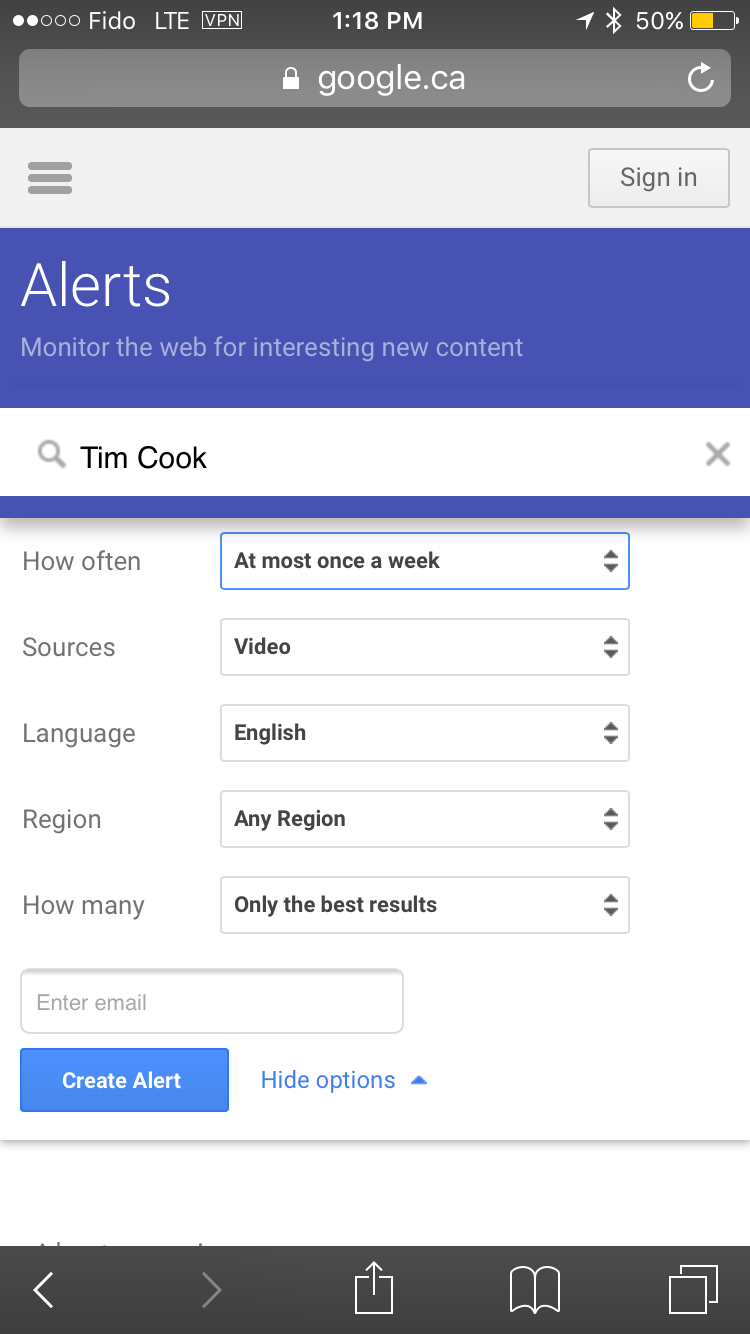
When you have identified the skill you need help with and the curated list of people who can help, this is where technology comes in. I don’t go searching for content. I use combinations of social media, subscriptions, and Google Alerts to deliver the content from my mentors to me. On YouTube I subscribed to the White House’s official channel which had all of Barack Obama’s videos nicely organized in one spot and I’d get a summary email weekly. Working at IBM makes it pretty easy to be notified whenever Ginni Rometty has a video worth watching. I follow various people on LinkedIn. I have a Google Alert that sends me all videos with Tim Cook in them on a weekly basis; it takes seconds to setup even on a mobile device:

img_9026

Other options include using RSS feeds, signing up to certain websites, following people or groups on Facebook/Twitter/etc., and more. Obviously these aren’t perfect since you often get other junk but it’s a good starting point and easier than intentionally making the time to go look for what you want.

To summarize, every good leader has traits they know they need to improve on. Millennial Leaders, in many cases, also have the challenge of leading people and working for people from other generations. Do not limit yourself from learning from only the people immediately around you. At the same time don’t be a victim of being too busy for mentoring by putting technology to work for you. I am personally very thankful to Tim, Ginni, Barack, and others for all the mentoring they have provided me with – even though they’ll never know!

We need better advice!

One of the reasons I started this blog is a lack of mainstream advice for Millennial Leaders, even by researchers who theoretically are experts on the topic.  While scrolling through my LinkedIn feed the other day an article popped up that summed up what I’ve been seeing (or not seeing) so I thought for today’s blog I’d critique it to highlight the challenge I face in getting high quality advice.  The Jan. 6, 2017 article is titled Top Employers Say Millennials Need These 4 Skills in 2017 and the author is Caroline Beaton who according to her bio is, “an award-winning freelance writer and speaker covering psychology, culture, social trends and millennial careers.”  I should add that I don’t know Caroline nor have I researched her other work.  I also haven’t interviewed more than 100 top HR managers, recruiters, and CEOs as she did for this article; rather, my critique is based on a) being a Millennial and b) my own observations over my decade+ career.

Foundation

The article’s main point is to uncover skills that entry-level job seekers need to display.  Right off the bat I question whether Caroline even knows her target audience.  If you read my 2nd blog Picasso you’d know that a Millennial is roughly 21-37 years old.  Assuming most people graduate with a 4-year post-secondary education around the age of 23 and giving them a generous 2 years to find their first role in their preferred field or complete further education/training, a typical Millennial would be in that entry-level position by 25.  This means that a large majority of Millennials aren’t currently looking for entry-level positions; they’re well past them!  This article is only useful for ~20% of Millennials at the tail end of the generation.

The article then goes on to highlight four skills that Millennials need so they can secure that entry-level position so let’s see how many of these are skills that apply more to Millennials.

Skill #1: Attention

I do somewhat agree with this one.  While generalizing, a typical Millennial has grown up in a world with more screens, notifications, devices, global social media, etc. relative to previous generations so being able to focus on one thing for many consecutive hours is not an innate skill.  The students that work for me along with me, to be fully truthful, always have a mobile device in our hands whereas I don’t observe that potential for distractions in some of the Gen Xers or Baby Boomers I work with.  This doesn’t mean that Millennials aren’t able to be very successful though so I wonder whether the absence of this skill is directly linked to job performance.  Perhaps it’s just a different style of working that prior generations aren’t used to?  I’d argue that when given a task or project, a person of any age would need to apply the appropriate level of focus and attention to get it done on time.

Skill #2: More than college

Putting aside that this isn’t really a single skill and is very industry specific, the author states that, “curiosity and commitment, not college, will be among the most important skills for millennials in 2017 and beyond.”  This is true but it doesn’t just apply to Millennials.  Given the rate and pace at which industries are being disrupted and the impact of new technology in every aspect of life, everyone in the workforce is going to need curiosity and commitment if they want to succeed at work.  How useful is a college/university degree gained 20+ years ago relative to one gained recently?  Sadly both are probably equally as useful.

Skill #3: Agility

I found this section confusing.  The author provides many definitions of agility such as,

  • “the ability to overcome.”
  • “not getting stumped at an early stage.”
  • “‘athleticism’: individuals who demonstrate resourcefulness, goals-driven behaviour, team player mentality and relentlessness.”

Huh?  I stepped back a bit to see the point that’s being made and my conclusion was that the author is really talking about persistence or tenacity as the skill.  Maybe it’s because I work in high-tech but to me agility is being able to successfully pivot your focus/priorities quickly to something different, whether that’s quickly learning a new skill, changing the scope of a project or deliverable, or reinventing something.  Definitions aside, while valuable advice for Millennials I’d argue again that this applies to everyone in the workforce given all the change going on.

Skill #4: Humility

I strongly disagree with this section!  To be clear I don’t disagree with the point—all employees need humility—but that this is being focused at Millennials is a little frustrating.  This section starts with the following sentence: “Not taking yourself too seriously, admitting when you don’t know stuff and asking for help when you need it are some of the most advanced skills of all.”  It ends with this: “On a day-to-day scale, people who think they know everything aren’t trainable, nor are they good collaborators. Admitting you’re a beginner, over and over again, takes practice.”  This is the exact advice I give to people who are mid- or late-stage career because I find they’re less humble or less willing to listen to different ideas or perspectives relative to early-stage career professionals.  I’m sure everyone can think of those one or more individuals who have been in their role for a long time, don’t change, don’t listen, and talk down to less experienced colleagues.  I recently had a colleague tell me that they have 20+ years of experience at multiple companies and because I am junior in years they wouldn’t take my advice (note: I’m at a higher job level so technically I outrank them), and have had a few similar situations throughout my career with longer-tenured colleagues.

Conclusion

The article is geared towards entry-level job seekers which encompass the tail-end of the Millennial generation and the leading edge of Generation Z.  I think having the word “Millennials” in the title is a bit misleading or maybe just click-bait-lite.  It should probably be titled Top Employers Say Entry-Level Job Seekers Need These 4 Skills in 2017.

It also talks about skills that for the most part apply to the entire workforce.  Imagine for a moment that it was only Millennials that needed these skills.  You’d have part of your workforce being highly focused, agile, be more than just their degree, and humble while the more mature part isn’t any of that—obviously that’s not the intention.  This is just generally good advice for anyone.  So maybe the title really should be Top Employers Say People in the Workforce Need These 4 Skills in 2017.

So what is the relevance for a Millennial Leader?  It means that we need to dig deeper to find meaningful and specific advice that can help us grow into better leaders.  It means analyzing the advice you’re given to determine whether it’s just generic advice dressed with a Millennial-labelled bow on top.  It also means that your leaders probably don’t even view you as a Millennial which could lead to differences in perspectives that can then lead to misunderstanding.

Hotshot, or not?

In late May 2013 I was a few weeks into my first people manager role.  I had been asked to take on the responsibility of running our organization’s IT Security Governance & Compliance team and our Customer Care team (essentially 1st level helpdesk).  The Customer Care side was about 10-15% of the role; it was a well oiled machine with dedicated staff that I inherited from another manager who ran it very well.  I essentially had to keep it going and look for ways to tweak/improve it where possible.  The IT Security side was much more complex: the team had lost a couple of people the month prior to me taking it on (including the highly experience manager who was promoted to an exciting position elsewhere in the company), it was suffering from an identity crisis within the organization, and generally IT Security is a challenging/high-risk topic.  So pretty exciting except for one minor detail: I had almost no experience in either space.  I had worked on teams and led projects in many areas of IT up to this point but none of them were in the areas I now owned.  The icing on the cake was that I was also younger than all but one of the employees I was now responsible for leading.

Given that context, the topic I want to cover in this blog post is how I thought about and prepped for a particular meeting, one I felt would make or break my ability to be successful.  Picture 31-year-old me about to have my first one-on-one/career discussion with the team lead on the IT Security team who was an employee with 38+ years of experience with the company.  Think about that.  The person’s career was longer than my life!  While prepping I literally remember wondering who would be giving the career advice.

I had a few objectives for the meeting:

  1. Build trust, as we hadn’t worked together closely before
  2. Determine what I could do to help the person with their career aspirations
  3. Request help, given I had no practical experience in that space and needed to learn fast
  4. Earn respect as the new manager of the team

#4 was the hardest one to prepare for especially since if I screwed that up it would have impacted the other three objectives.  I didn’t want to come across as a pushover from the beginning yet I also didn’t want to come across like some hotshot know-it-all either.  It’s tempting for people in management roles to be authoritative from the beginning but I really felt that this kind of approach wasn’t going to help me meet the objectives of the meeting.  I was genuinely confident in my abilities but had to ensure that confidence came across in the right way.

To build trust I figured the best approach was honesty (shocker!).  During the meeting I opened up about myself and my family, my career goals, why I wanted to get into management, the knowledge gaps that I had in IT Security, and my weaknesses.  I asked them the same things too so I could learn about them as a person as well as where they saw themselves in the coming years, their motivations, what kind of work environment they thrived in, and more.  This informal approach to start the meeting led to relationship building which is essential between a manager and an employee.

I was fairly blunt in my request for help.  I asked where they felt I should focus, what the strengths and weaknesses of the team were, how I could be most helpful and also how could I ensure I didn’t get in the way.  I asked open-ended questions and let my employee do most of the talking.  By being blunt I was able to set the tone for the next few months: that I would be counting on the person to help me learn and that it would mean more effort on their part, i.e. run the team and train the manager.  I didn’t sugarcoat and by being clear on what I needed from them it set us both up for success.

Almost nobody is going to earn respect in a single meeting so I wanted to lay a foundation that would allow me to earn the necessary respect one needs to succeed as a leader.  I outlined my management style but was honest about the fact that what I had outlined was just a theory and that it would evolve as I grew into the role.  I asked for insight into what they felt were the characteristics of the better managers they had during their career.  What I think was probably the most important thing though was that I created a culture of feedback.  I knew I was going to make mistakes so I asked to be called out whenever they felt I was going down the wrong path.  I wanted them to know that I would take that feedback seriously and without repercussions to them (this also helps with building trust).

Overall the meeting went very well and was the launchpad to years of great work between the two of us and the rest of the team.

As Millennials take on leadership roles I think many of the lessons here are key since they will likely have more experienced people working for them given the current mix of generations in the workforce.  Show respect for that experience and be humble about your current level of skill and experience.  Ask for help and show your appreciation when helped.  Ask for feedback, and more importantly act on it (otherwise you’ll find the feedback will dry up real quick). Yet, be confident because ultimately you were selected to lead based on your track record and potential.  New ideas and perspectives combined with the wisdom gained over years of experience can lead to wonderful outcomes for Millennial leaders and the teams they lead.